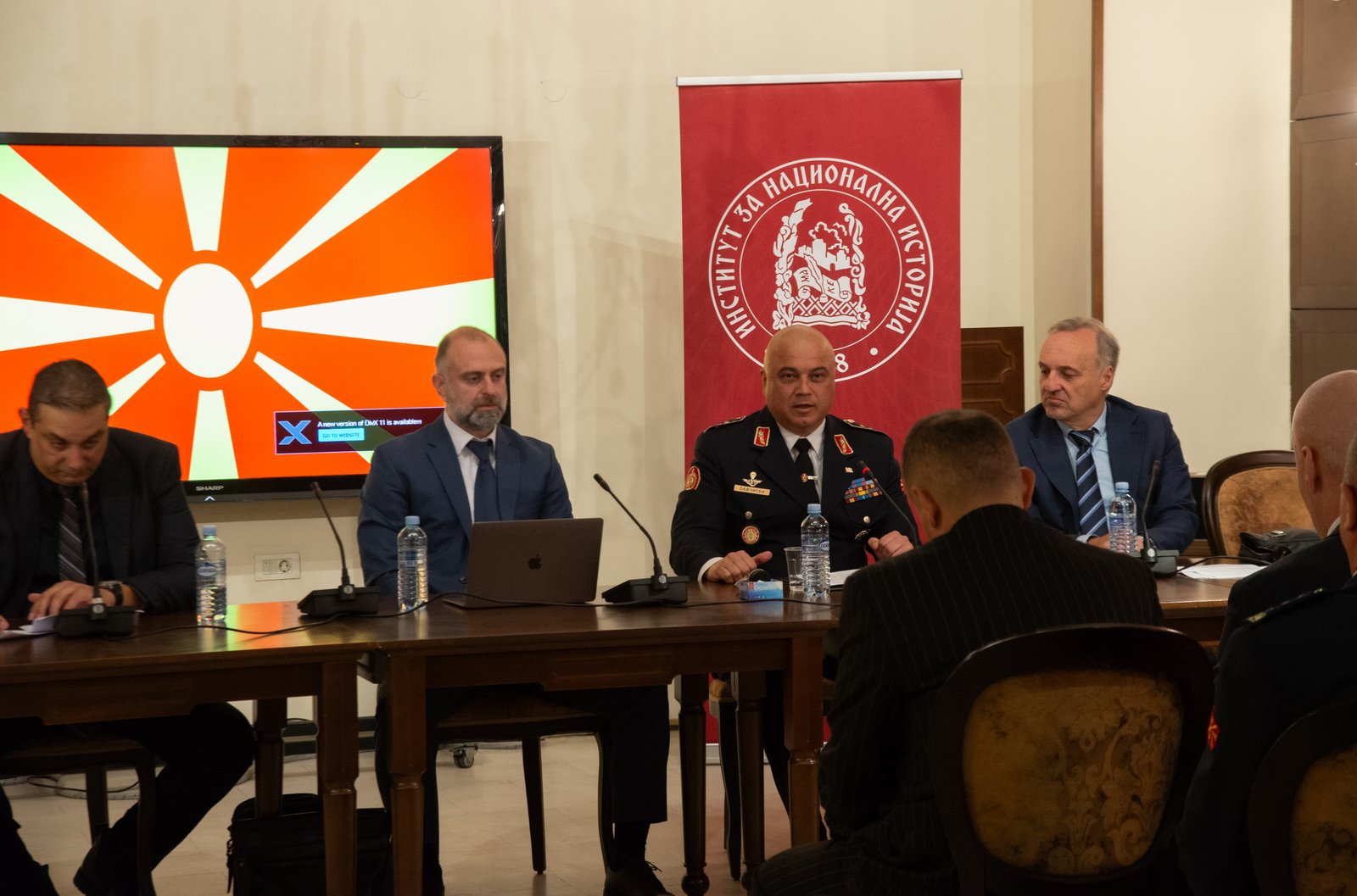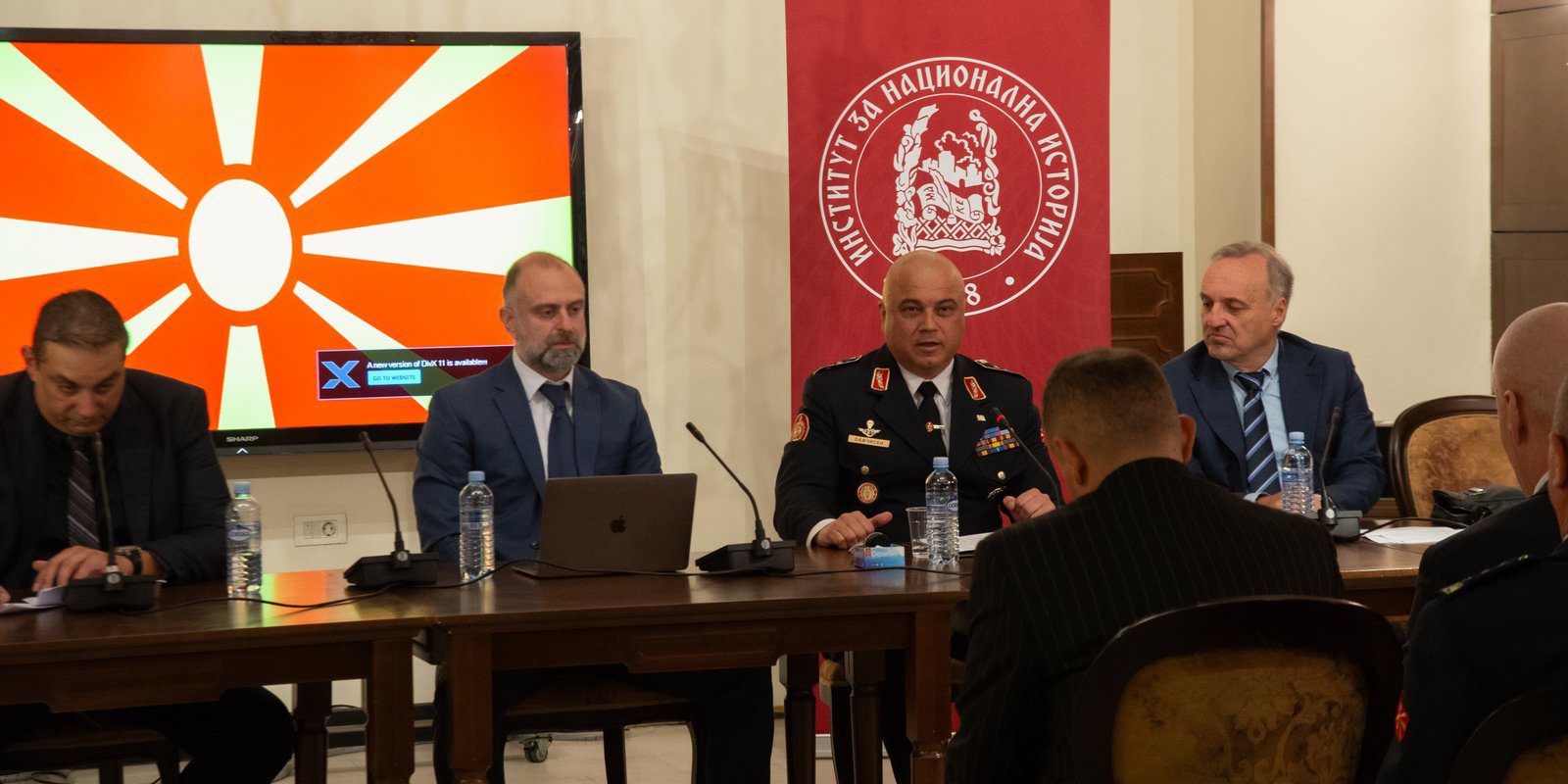
Today, the Chief of the Army General Staff, Major General Sashko Lafchiski, participated in a panel discussion as part of the “History and Strategy Dialogue” series, held at Porta Macedonia. The event was organized by the Institute of National History – Skopje, in cooperation with the Konrad Adenauer Foundation.
The topic offered an in-depth analysis of the contemporary security challenges under the title “Evolution or Revolution in Warfare? From the Gulf War to Ukraine: Continuity, Change and the Future of NATO Collective Defense”. The discussion focused on changes in the way modern armed forces are organized and operate. Particular emphasis was placed on technological advancements, including unmanned systems, artificial intelligence, electronic warfare and network-enabled command and control, all of which are directly transforming the dynamics of the battlefield. Strategic capabilities such as logistics, industrial capacity and the speed of adaptation in crisis situations were also examined.
During the panel discussion, General Lafchiski addressed the historical continuity of military thought and the need for timely doctrinal adaptation within modern armed forces, emphasizing: “Technology drives revolutionary changes, but adaptation, leadership and human potential determine how these changes are translated into military and strategic victory. Technology alone cannot manage everything required for success on the battlefield. It gives you an advantage, but strategic victory requires evolution. This is clearly evident in Ukraine as well, although the use of drones, artificial intelligence and sensors is impressive, the decisive factor ultimately remains the same: who is capable of adapting more quickly.”
Throughout the panel, participants engaged in a discussion from a historical perspective, drawing on experiences from the Gulf War in 1991, the conflicts in the Balkans, Afghanistan and Iraq, through to the war in Ukraine. The debate explored whether the world is currently witnessing a continuous evolution or a complete revolution in military affairs, viewed through the lens of NATO collective defence.
The panel was attended by accredited military attachés in the Republic of North Macedonia, as well as experts from the academic community. Representatives, professors and students from the Military Academy also attended the event and the moderator of the discussion was Associate Professor Dr. Zoran Ivanov.