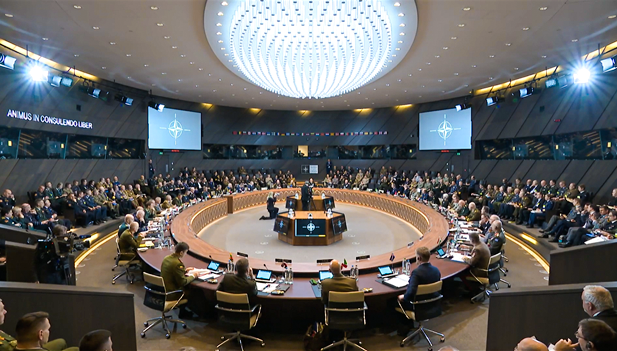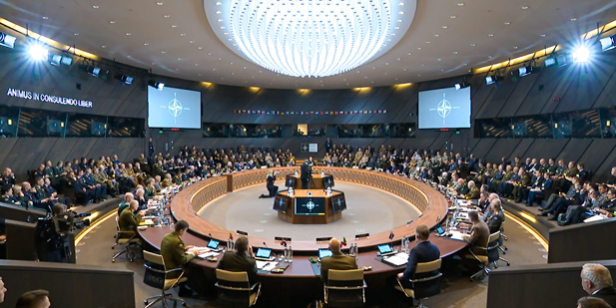
The Chief of the General Staff of the Army, Major General Sashko Lafchiski participated in the regular meeting of the NATO Military Committee in the format of Chiefs of Defense from NATO member states and partner countries yesterday and today.
The meeting was led by the Chair of the NATO Military Committee, Admiral Giuseppe Cavo Dragone. The NATO Secretary General, Mark Rutte addressed the participants and expressed gratitude for their continued support and clear leadership in strengthening Allied deterrence and defense. Moreover, Rutte highlighted the progress achieved since the Hague Summit, focusing on increased defense investments, enhanced military production, and continued support for Ukraine. In his closing remarks, the Secretary General stated: “We will continue to work closely with our partners around the world, because security is a joint effort.”
In his address, Admiral Dragone emphasized that the security environment remains extremely complex, pointing to the war in Ukraine, instability and violence along NATO’s southern neighboring countries, open tensions, as well as the activities of other malign actors that continue to threaten global stability. Reflecting on NATO’s activities, Admiral Dragone stressed that over the past year, through the successful operations Baltic Sentry and Eastern Sentry, and an increased number of military exercises, NATO’s vigilance and the Alliance’s defense and deterrence capabilities have been strengthened, confirming the exceptional adaptability of NATO’s strategic commands. In conclusion, Admiral Dragone emphasized that security is not only an issue for politicians and the military, but concerns everyone in Allied nations, stating: “That is why we need not only support, but genuine engagement from more than a billion people whom we are committed to defending.”
During the meeting, the Supreme Allied Commander Europe (SACEUR), General Alexis G. Grynkewich, briefed the Chiefs of Defense on NATO’s readiness in strengthening collective deterrence and the defense of the Alliance. Afterwards, the Supreme Allied Commander Transformation, Admiral Pierre Vandier presented his views on the future, including how NATO is accelerating the delivery of key capabilities to ensure that Allied forces are prepared for current threats and future security risks. He placed special focus on partnerships, including the NATO-Ukraine Council, Indo-Pacific partners, and the European Union.
At the meeting, General Lafchiski actively participated in discussions on issues related to global security challenges, the Alliance’s readiness for deterrence and defense, interoperability, threats, risks and challenges, as well as cooperation with partner countries. In his briefing, he emphasized the commitment of our Army to regional security through participation in peace support missions, operations, and NATO activities abroad, particularly the NATO mission in Kosovo (KFOR), the EU operation ALTHEA in Bosnia and Herzegovina, as well as the NATO activity Forward Land Forces – FLF in Bulgaria and Romania.
In addition, General Lafchiski also referred to the national exercise Flash 26, which will focus on the evaluation of the Light Infantry Battalion Group (LIBG) as our primary NATO capability target. The exercise will also serve as a platform for aligning national and NATO obligations. Additionally, he emphasized the strengthening of the readiness of our Army through continuous modernization and equipping.
Moreover, General Lafchiski held a bilateral meeting with the Chief of the General Staff of Hungary, General Gábor Böröndi. They discussed about deepening of the bilateral military cooperation, emphasizing joint training between service personnel of our Army and the Hungarian Armed Forces, as well as opportunities for equipping and modernization.
During his stay in the Kingdom of Belgium, General Lafchiski also met with Army service personnel who are deployed to the National Military Representation of the Republic of North Macedonia at the NATO Headquarters in Brussels.
At the meeting, led by the Chair of the NATO Military Committee, Admiral Giuseppe Cavo Dragone, there were other participants, including General Alexis G. Grynkewich and Admiral Pierre Vandier, the Chiefs of Defense of the 32 NATO member states as well as representatives from NATO’s Indo-Pacific partners, Georgia, and Ukraine.