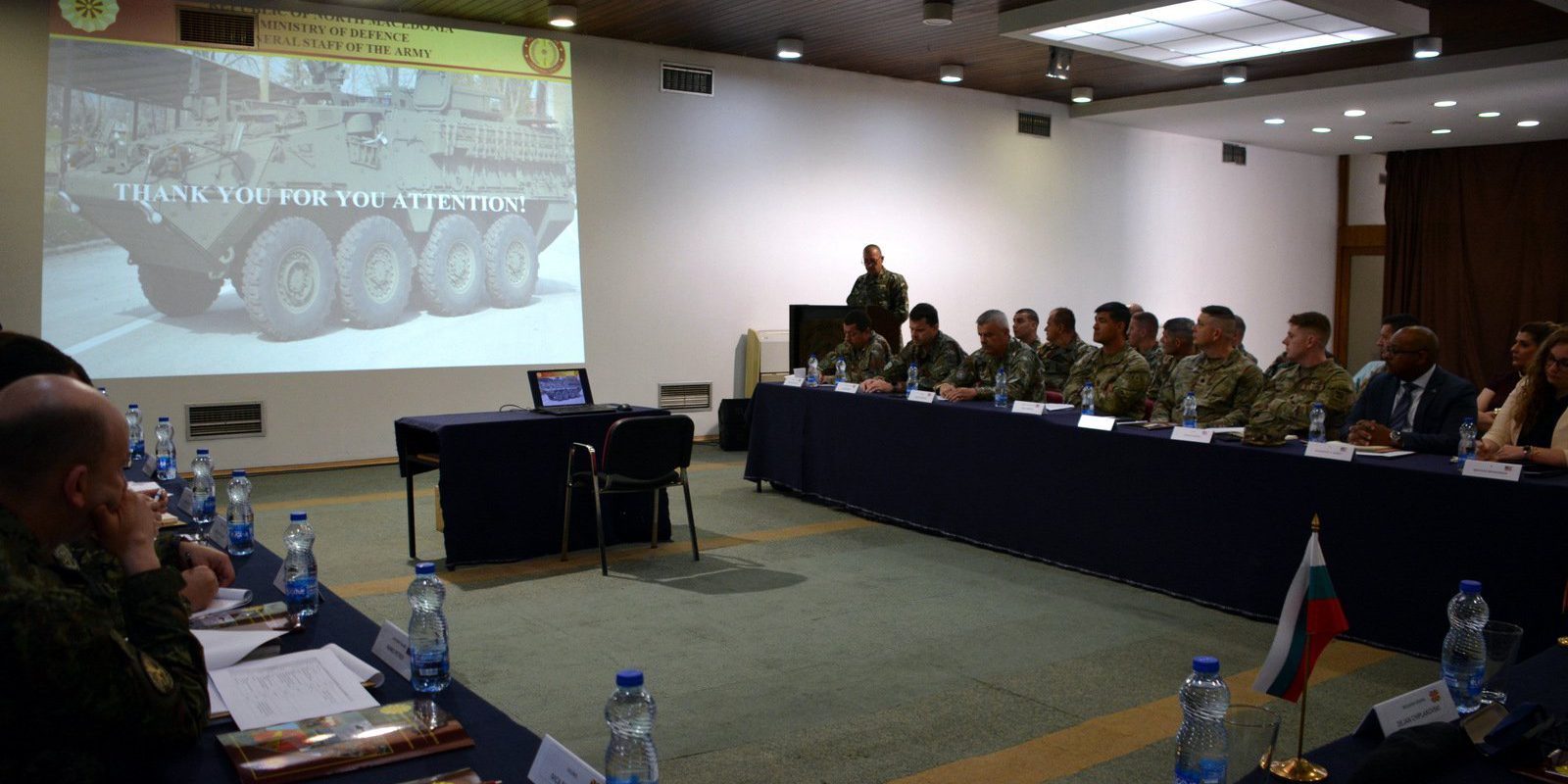
The Army hosted the second Stryker Training Conference from 9 to 11 June at the Army House in Skopje.
The conference brought together representatives from the United States, including the Washington National Guard, U.S. Army Europe and Africa, the 7th Army Training Command, and the 2nd Cavalry Regiment, as well as representatives from the Republic of Bulgaria, the United States Military Group in the Republic of North Macedonia, and the Office of the U.S. Defense Attaché.
The conference was opened by the Director of the Army General Staff, Brigadier General Orce Jordev, who highlighted the Army’s commitment to developing capabilities related to the operation of Stryker armored combat vehicles and its role as a credible NATO ally.
During the working sessions, participants reviewed about national training programs, and disused opportunities for enhancing the combined training framework, challenges related to the maintenance and sustainment of the systems, and operational experiences gained through the use of Stryker vehicles. Participants also had the opportunity to familiarize themselves with the Army’s training and maintenance capabilities for these combat vehicles, as well as with the plans for their further development.
At the end of the conference, joint guidelines were adopted and signed, establishing guidelines for future cooperation and joint activities in the areas of training, maintenance, and capability development related to the Stryker platform.
As part of the conference program, the Chief of the General Staff of the Army, Major General Sashko Lafchiski, met with Brigadier General Paul Sellars of the Washington Army National Guard. During the meeting, both sides reaffirmed their commitment to further strengthening bilateral military cooperation, exchanging professional experience, and enhancing capabilities related to the operation and maintenance of Stryker vehicles.
The conference represented a significant contribution to strengthening interoperability among Allies, promoting the exchange of expertise, and advancing collective capabilities within NATO.