


Mission:
Provides air support and transport for Army units, surveillance of the airspace of the Republic of North Macedonia, and air defence for deployed units and key facilities at low altitudes. It ensures full sovereignty over the national airspace and participates in peace support operations outside the country. In addition, during natural disasters and catastrophes, it provides support to civilian structures in dealing with emergencies and crisis situations, such as search and rescue, firefighting, and medical evacuation.
Tasks:
• Coordination and control of the plans of subordinate units;
• Planning and implementation of measures, activities, and procedures to raise the level of combat readiness in accordance with the assessed security situation and received orders;
• Air support to Army units;
• Planning and implementation of activities and procedures to support central and local authorities in responding to natural disasters;
• Organization and conduct of surveillance, control, and protection of the sovereignty of the country’s airspace;
• Continuous monitoring of aircraft in the country’s airspace;
• Navigational assistance to aircraft;
• Identification of aircraft in the country’s airspace;
• Air defence of deployed units and key facilities across the territory;
• Training, conversion training, and continuation training of pilots for the needs of the Army and the Ministry of Defence;
• Dissemination of the recognized air picture to designated users;
• Automatic digital exchange of regional air situation data;
• Preparation for mobilization;
• Achieving and maintaining combat readiness;
• Training of personnel for participation in multinational, peace support operations, and in the fight against terrorism;
• Participation in exercises with NATO and coalition partners.
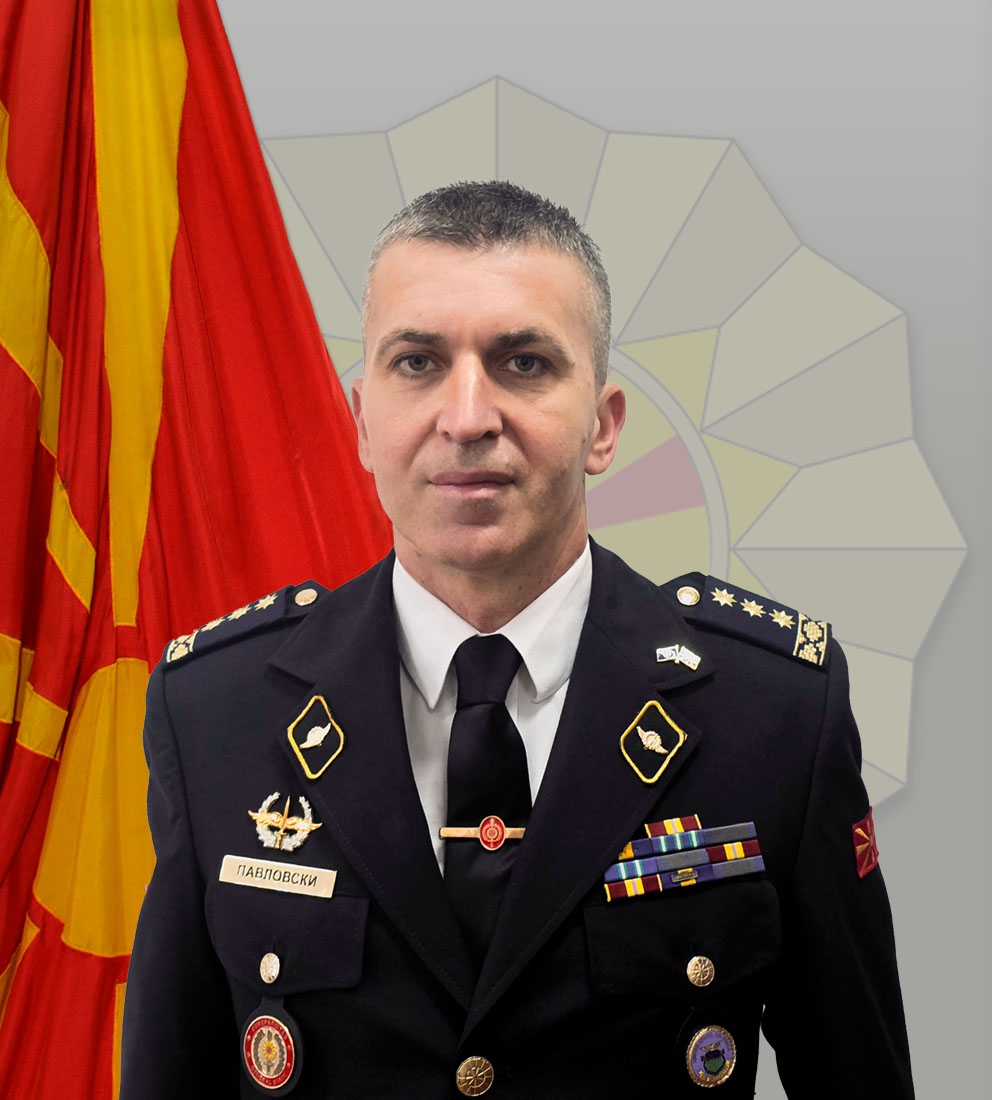
Colonel Dragan Pavlovski
Date and place of birth: 29 October, 1975 in Kumanovo, Republic of Macedonia.
Education
In the period from 1990 to 1994 he attended the “Goce Delchev” high school in Kumanovo, and in the period from 1994 to 1998 he studied and graduated from the Faculty of Law, the “Ss. Cyril and Methodius” University, Skopje (Department of International Diplomacy). With several years of prior flying experience, in 2002 he successfully completed professional training and advanced education for officers at the Military Academy in Skopje, specialization in Aviation. He finished the training as a pilot of the Zlin 242L aircraft. He acquired the titles of first pilot, instructor, and flight instructor of the Mi-8MT/17 transport helicopter, as well as class 1 pilot. From 2015 to 2016, he graduated from the Air Command and Staff College (ACSC) at the Air University at Maxwell Air Force Base in Montgomery, Alabama, USA.
Military career
He began his military career as a pilot in a training squadron. In his career until now, he has held various command and staff duties in the transport helicopter squadron, a combat helicopter squadron, the Air Force VING Command and the Joint Operations Command. From 2020 to 2025, he was assigned to an international duty at the NATO Headquarters in Brussels, and upon his return, he continued to work at the Ministry of Defense. In his career until now, he has received 77 awards, commendations, letters of appreciation and certificates for his work, as well as for participation in national and international activities.
International Recognitions
- He has received two Certificates and has been awarded two European Security Defense Policy Service Medals by the former EU High Representative and former NATO Secretary General, Dr. Javier Solana, for his participation in the missions of the European Union – Operation ALTHEA in Bosnia and Herzegovina, for a total of two rotations, in 2006 and 2008.
- He has received a certificate from the Chief of Staff of the NATO Joint Force Command in Naples, Lieutenant General Antonio Vittiglio (NATO JFC Naples, Italy) for excellent implementation of the exercise REGEX 19 in the role of the Officer of Primary Responsibility (OPR).
- In the period from 2020 to 2025, he was assigned to an international duty within the Permanent Delegation of North Macedonia to NATO Headquarters in Brussels, Kingdom of Belgium. For this, he has received letters of appreciation from NATO for participating in the work of the committees and working bodies in the field of Air Defense and Missile Defense.
Participation in significant courses, seminars and trainings
- Flight training and obtaining the title Pilot in Air Defense and Anti-Aircraft Defense, Skopje, 2002;
- Instructors Course, Techniques for Military Training and Instruction, Skopje, 2003;
- NATO Evaluator Course, Level 1, Skovde, Sweden, 2007;
- Seminar on Receptions, Protocols and Other Military Events of EUFOR, Sarajevo, Bosnia and Herzegovina, 2008;
- NATO Evaluator Course, Level 2, Advanced Level, TACEVAL, NATO School, Oberammergau, Germany, 2009;
- NATO Evaluator Course, Practical Final Components, Bucharest, Romania, 2010;
- Staff Positions Course, Military Academy, Skopje, 2010/2011;
- Seminar on Planning Mission for Aviation Unit, team from Vermont-USA, Petrovec, 2012;
- Seminar on Risk Management, team from Vermont-USA, Petrovec, 2012;
- Seminar on Air Search and Rescue, RACVIAC Security Center, Zagreb, Croatia, 2012;
- Media Instructor Course at the Public Affairs Regional Centre (PARC), the Ministry of Defense, 2012, 2013 and 2014;
- NATO Seminar on Environmental Protection and Management in Wartime, Ohrid, 2015;
- NATO Planning Exercise Process Course, Podgorica, Montenegro, 2016;
- NATO Information Operations Course, NATO School, Oberammergau, Germany, 2017;
- NATO Helicopter Seminar, Krakow, Poland, 2017;
- Open Skies Course, NATO School, Oberammergau, Germany, 2018;
- NATO Regional Collective Training on Exercise Planning, team of experts from NATO Joint Force Command Naples, Skopje, 2018/2019;
- Seminar on Crisis and Emergency Situations Management, Skopje, 2019
Participation in national and international exercises
National exercises: Macedonian Flash, Balkan Flash, 2010; Challenge, 2011, 2012 and 2018; Longbow Lancer, 2012; B-9, Wise Wolf, 2012; Joint Reaction, 2017; Autumn Storm, 2018 and Regional Exercise REGEX, 2019.
- International exercises: Cooperative Key, 2005, Plovdiv, Bulgaria; Eagle SAR, 2005, Tirana, Albania; Arms Control, 2008, Rovaniemi, Finland; Logical Decision, 2010, Papa, Hungary; VIKING 11, 2011, Livgarden, Sweden; Rapid Trident, 2012, L’viv, Ukraine; Logical Decision, 2012, Szolnok, Hungary; Immediate Response, 2013, Zagreb, Croatia; Immediate Response, 2014, Postojna, Slovenia; Adriatic Strike, 2018, Cerklje, Slovenia; Anatolian Phoenix, 2019, Konya, Turkey and REGEX 20, 2020, Rabat, Morocco.
Significant Work Activities and Engagements
Colonel Dragan Pavlovski has participated in activities as a NATO evaluator, level 1 and level 2 in country and abroad. He was the first coordinator for the launch of the Air Policing mission in the airspace of the Republic of North Macedonia, a member of the working group for the implementation of the strategic goals for NATINAMDS as part of the Access and Integration of the Republic of North Macedonia into NATO, a member of the working group for Standardization in the field of Air Force, Operations and Armaments, a member of the working group for the Development of SOPs, responsible for the implementation of the Partnership Goals in the Military Air Force. Later, he became the national representative in NATO committees and working bodies.
Colonel Pavlovski was the leader of the Integrated Project Team for the procurement of multipurpose transport helicopters, as well as the Project Manager for the completion of the modernization of the helicopters. He is an instructor at the Public Affairs Regional Centre (PARC) at the Ministry of Defense, as the only NATO-accredited center in the country in the field of public relations and strategic communications within the Alliance. He has also been a lecturer at the Military Academy “General Mihailo Apostolski”, Skopje, as a subject matter expert in aviation practices. He actively writes articles for the Shield magazine, focusing on NATO and military aviation topics.
Colonel Dragan Pavlovski is married, father of two children.
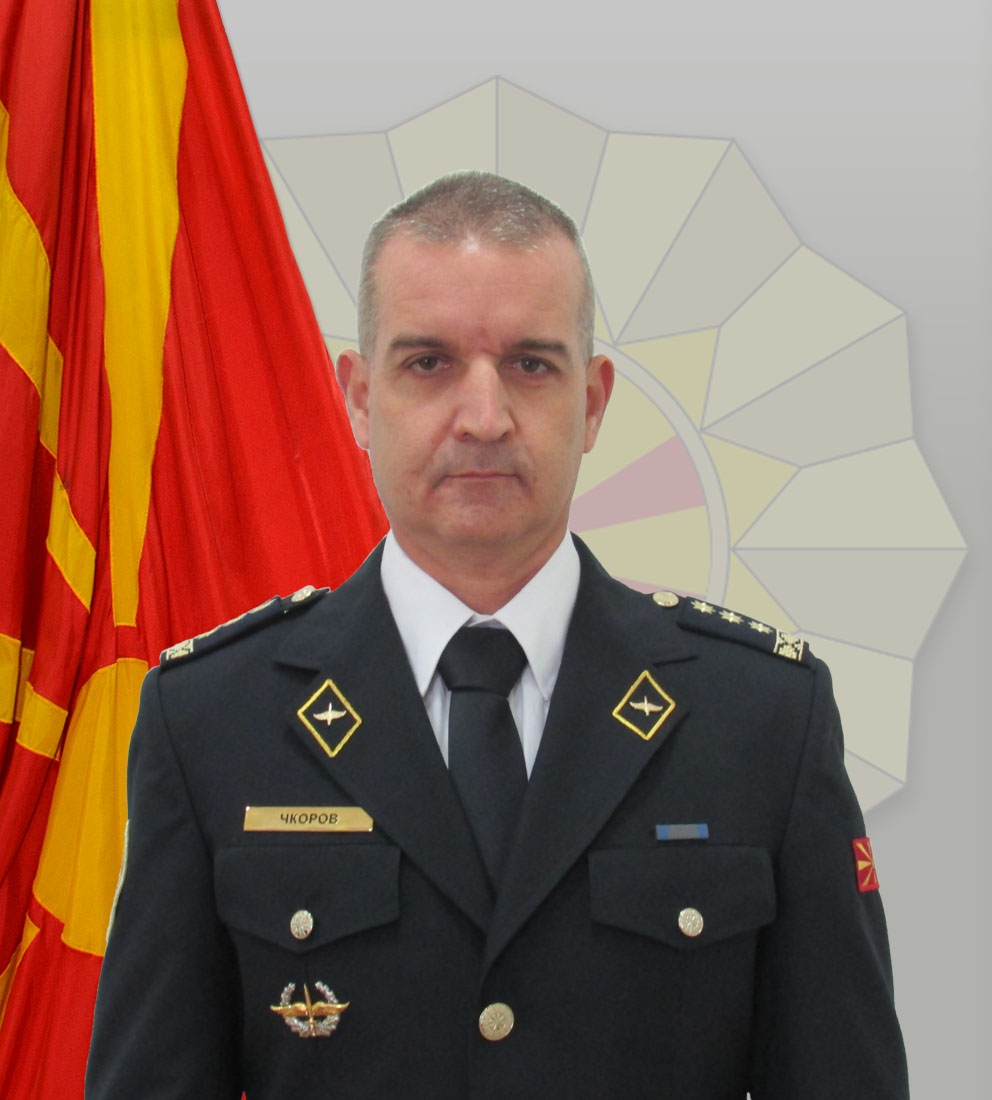
Colonel Igor Chkorov
Colonel Igor Chkorov was born on 24th April 1974 in Zagreb, the Republic of Croatia. After finishing elementary school and electro-technical high school in Zagreb, he continued his education at the Faculty of Mechanical Engineering in Skopje. In 2002 he completed an aviation officer course at the Military Academy “General Mihajlo Apostolski” in Skopje.
He started his military career as a pilot at the training squadron. In his career so far, he has had several command and staff duties on a flight, squadron and command level. He has been appointed Deputy Commander of the AF WING since 31st December 2021.
He is a pilot of a Zlin 242 L and a pilot and instructor of Mi-24 helicopters.
He has participated in many military exercises, at home and abroad: Flash, Challenge, Logical Decision, Adriatic Strike and other. Upgrading his military education he has completed an instructor’s course, NVG training flight in France, Aviation Technical Terminology Course in Turkey, TACEVAL Evaluator Course in Germany, and Command and Staff School at the Military Academy “General Mihajlo Apostolski”.
He has been awarded and commended on numerous occasions. He is proficient in English. Colonel Igor Chkorov is married and a father of two.
Previous duties:
He has had the following duties:
- Training Squadron Pilot, 2002-2004,
- Combat Helicopter Squadron Pilot, 2004-2005,
- Pilot-Flight Deputy Commander, at the Combat Helicopter Squadron, 2005-2008,
- Flight Commander, at the Combat Helicopter Squadron, 2008-2011,
- Operations Officer – Combat Helicopters Squadron Deputy Commander, 2011-2013,
- Chief of Staff – Combat Helicopters Squadron Deputy Commander, 2013-2015,
- Combat Helicopters Squadron Commander, 2015-2020,
- Chief of Operations and Combat Readiness Section, at the AF WING Command, 2020-2021,
- AF WING Deputy Commander, since December 2021.
Promotions:
- Lieutenant 2002-2006,
- Captain 2006-2011,
- Major 2011-2016,
- Lieutenant Colonel 2016,
- Colonel 2023.
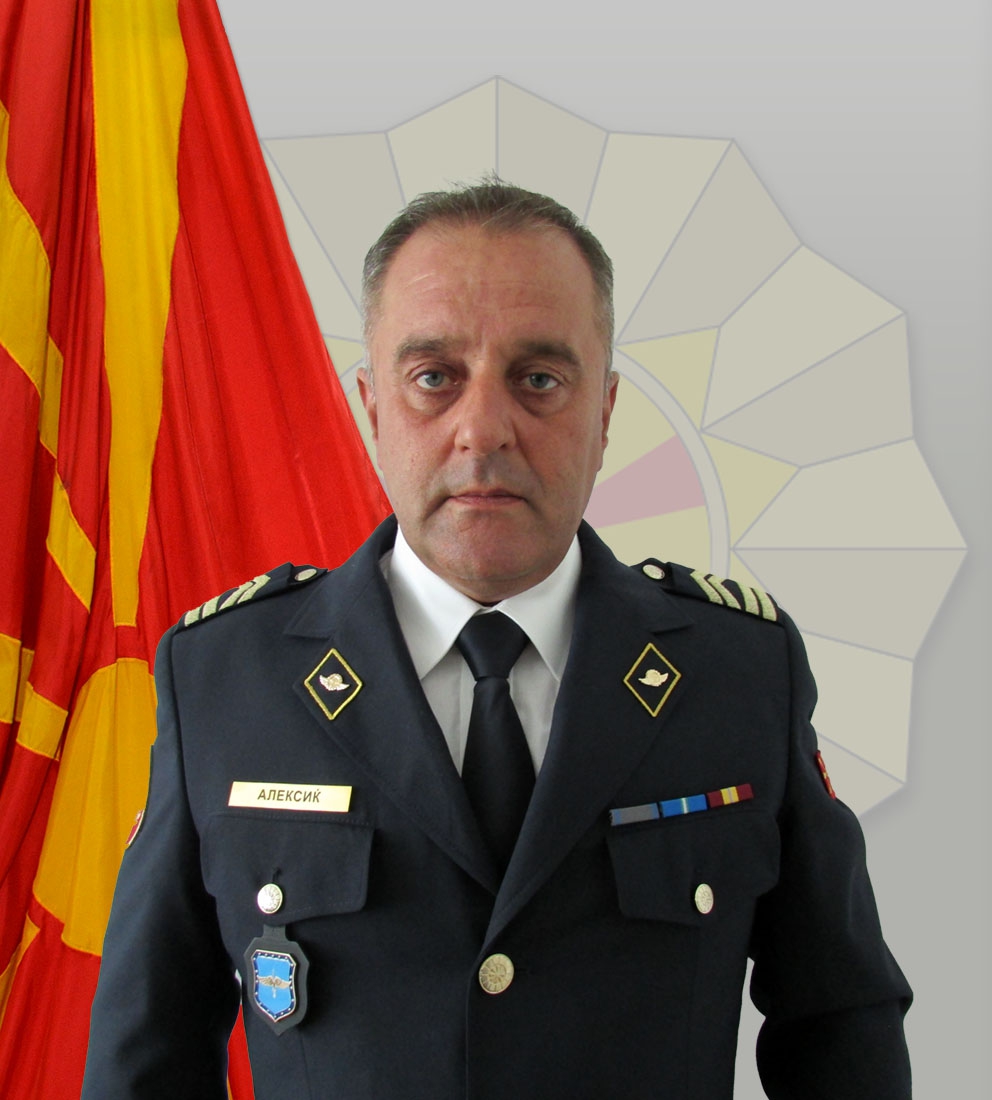
Chief Master Sergeant Toni Aleksikj
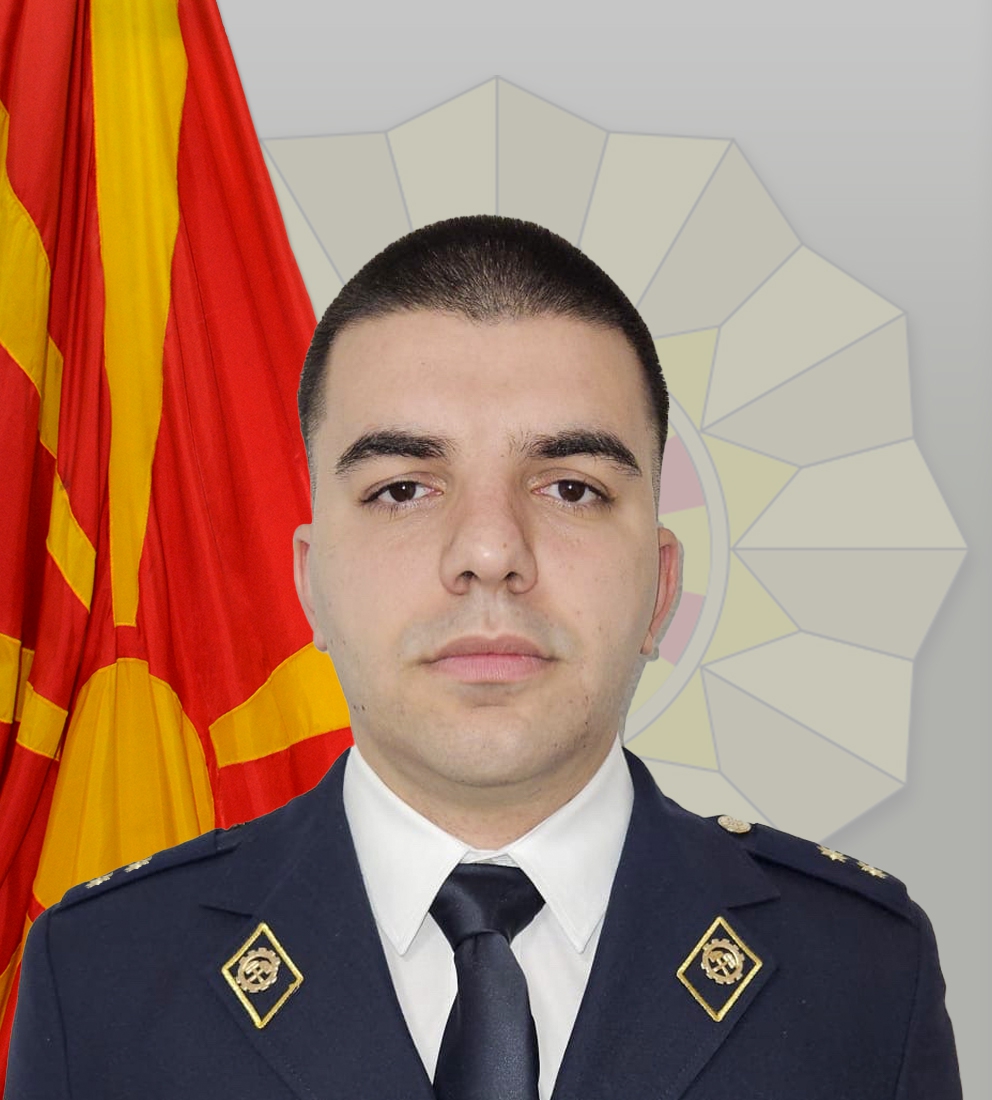
Lieutenant Jasir Islami
Lieutenant Jasir Islami was born on 11 January 1997 in Skopje, where he finished elementary school. He completed his secondary education at the high school “Zef Ljush Marku” where he studied from 2011 to 2015.
In 2019, he graduated at the Faculty of Mechanical Engineering at Ss. Cyril and Methodius University in Skopje, specializing in Mechatronics. In 2022, he successfully completed the Professional Training and Development Course for Service Officers in the Army, thereby beginning his career as an officer.
During his professional development, he has attended several courses in country and abroad:
- „Protocol Course“ – Skopje, 2022;
- „Basic Public Affairs Course“ – PARC, Skopje, 2024;
- „Strategic Communication Course“ – RACVIAC, Zagreb, 2024;
- „Public Affairs in International Operations Course“ – PARC, Skopje, 2024;
- „Public Affairs Workshop“ – DMTC CAF, Sarajevo, 2024.
He has twice received commendations from the Commander of the Operations Command and once from the Chief of the General Staff of the Army. In addition, he has been awarded incentive leave in recognition of his achievements and contribution to the execution of official duties.
Previous Duties:
- Commander of Logistics Support Platoon in Signals Battalion, 2022;
- Protocol Officer in OC, 2022-2024;
- Public Affairs Officer in AF WING, since 2024.
Promotions:
- Lieutenant – 2022.
Foreign Languages:
- English;
- Spanish.
The Military Aviation Force of Republic of Macedonia was established on 10th of April 1992 with a decree issued by Kiro Gligorov, the first President of the Republic of Macedonia. Thus the first Macedonian Air Force and Air Defense Command with its Aviation Brigade composed of Aviation, Transport and Combat Helicopter Squadrons was established.
The 10th of June is celebrated as the day of the Macedonian Air Force and Air Defence, since it was the date of the first flight of the Macedonian Air Force with UTVA-75 plane.
The Air Force of the Republic of Macedonia developed since its founding:
- Aviation Brigade, under the Joint Operations Command since 2012.
- Air Force Wing, under the Joint Operations Command since 01st December 2005 (AF and AD Command was disbanded on 30th September 2005);
- Air Force Wing, under AF and AD Command since 2002;
- Aviation Battalion, under AF and AD Command since 2001;
- Aviation Brigade, 1994;
- Aviation Brigade, formed in 1992.
1992
- In 1992, the Government of the Republic of Macedonia (published in the Official Gazette No. 7, February 10, 1992) adopted two decisions regulating aircraft overflights in the country’s airspace. The Air Force and Air Defense, as a branch of the Armed Forces, was established on 10 April, 1992, by decision of the first President of the Republic of Macedonia. A Directorate for Air Force and Air Defense was formed within the Army General Staff, along with a Command consisting of: an Aviation Brigade, a Light Artillery Missile Regiment (LAMR AD), an Air Surveillance, Reporting and Guidance Regiment (ASRGR), and an Air Base.
- After completing theoretical training, with an order by the Air Force and Air Defense Command, the practical flight training began on 10 June, 1992 i.e. instructors retraining. In accordance with the flying plan of the Air Brigade from 9 June, 1992, the first Macedonian military crew to fly consisted of officers Dane Ilievski and Aleksandar Manev, flying an Utva-75 aircraft. The flight lasted 20 minutes (10:15-10:35) in the Drachevo flight zone. For that occasion, 10 June is celebrated as the Day of the Air Force.
- The Light Artillery Missile Regiment (LSMR AD) was equipped with Strela-2M light portable air-defense missile systems and anti-aircraft guns 40mm and 20/3mm.
- The ASRG Regiment for airspace control did not possess radar systems, and this shortcoming was compensated by organizing so-called ground-based air observation stations, staffed with a certain number of personnel acting as visual observers of the airspace across designated sectors and directions. Coordination was carried out with the Directorate of Civil Aviation, specifically with the airport air traffic control at Petrovec Airport (which used a secondary radar system of the “Thomson” type) and with the airport air traffic control at Ohrid Airport. The collection, processing, and presentation of data on the airspace situation were coordinated and conducted within the Operational Center of the Air Force and Air Defense Command.
- In those turbulent and unstable conditions, the formation of the Air Force and Air Defense began on 28 February 1992 at the JNA House, initiated by Colonel Mile Manolev and in cooperation with the first Minister of Defense following the adoption of the Constitution of the sovereign and independent Republic of Macedonia. By order of the Minister of Defense, Brigadier General Mile Manolev was appointed as the first commander of the Air Force and Air Defense, serving in the period from 1992 to 1996.
- A Directorate of Air Force and Air Defense with four departments (aviation, air defense artillery, ASRG department, and air-technical security) was established within the General Staff of the Army of Republic of Macedonia.
1994
- Equipping the Macedonian Air Force and Air Defense with helicopters that could be used by emergency medical services became a top priority for the country. Despite the still-active United Nations embargo on the import of weapons and military equipment, in 1994 the Macedonian military aviation managed to acquire four transport helicopters of the Mi-17 type. On 28 June 1994 at 09:32, the Air Force and Air Defense units received their first Mi-17 helicopter. Macedonia succeeded in purchasing and equipping its own military aviation with new, civil configured Mi-17 transport helicopters. Immediately after delivery, the helicopters were used for the official activation of the 301st Transport Helicopter Squadron
1995
- On 15 November 1995, the Republic of Macedonia signed the Framework Document for accession to the Partnership for Peace Program, thereby becoming the 27th member of the initiative. Partnership for Peace is a NATO program aimed at fostering cooperation and building trust between NATO member states and other countries, with the goal of increasing stability and security across Europe. Following the Republic of Macedonia’s admission to the Partnership for Peace, some officers from the Air Force and Air Defense Command took active part as observers in international exercises organized by NATO.
- During 1995, a primary two-dimensional radar system, the “NAR M-61,” manufactured under license from the French company “Thomson,” was procured. This radar had previously been located at Ohrid Airport, where it was faulty and out of service. Members of the unit relocated, installed, and repaired the radar. With the radar becoming operational, intensive training was conducted for personnel from the ASRG branch, while at the same time intensive activities began at the Air Force and Air Defense Operational Center at Drenov Dol
1996
- At the beginning of 1996, ZLIN-242 training aircraft arrived from the Czech Republic. The aircraft were used to establish the 101st Aviation Squadron. This type of aircraft is suitable for basic pilot training, aerobatics, navigation, instrument and night flying, formation flying, and the execution of combat maneuvers.
1997
- At the beginning of 1997, a Study on the modernization of airspace management was prepared by the U.S. Air Force’s Airborne Electronics Systems Center, providing specific and detailed recommendations. As a result of this initiative and the completed study, certain activities began for the establishment of a Center for the Protection of Airspace Sovereignty. This center was intended to operate according to NATO standards and, with an integrated air defense system, would later be connected to NATO’s Integrated Air and Missile Defense System (NATINAMDS).
2000
- In the period from 04 to 14 September 2000, members of the Air Brigade, using Mi-17 transport helicopters, participated in a NATO (Partnership for Peace) exercise known as “Cooperative Key.” The exercise was conducted in Constanța, Romania. This marked the first international presentation of our forces and helicopters, as well as the first flight outside the airspace of the Republic of Macedonia following independence. The positive results demonstrated in the engagement of the Air Force and Air Defense representatives brought another significant international recognition and confirmed the high level of proficiency of both the flight and technical personnel.
2001
- In the period from 17 March to 04 September 2001, the Air Force expanded its arsenal with Mi-8 and UH-1H helicopters for a transport helicopter unit, Mi-24 and Mi-24K helicopters (intended for battlefield reconnaissance and artillery fire correction) as part of a combat helicopter unit, as well as Su-25 aircraft for a combat aviation unit.
- In June 2001, by Decree No. 28, Colonel Zvonko Stojanovski was appointed, under both peacetime and wartime formations, as Commander of the Air Defense and Air Force Command within the General Staff of the Army of the Republic of Macedonia. Subsequently, by Decree No. 32, Colonel Zvonko Stojanovski was promoted to the rank of Brigadier General. As Commander of the Air Force and Air Defense from 2001, General Stojanovski performed his duties until 2003.
- To strengthen air defense, missile systems of the Igla-1 and Strela-10 types were procured. At the “Strasho Pindzhur” Barracks in Petrovec, a training course was completed for officers of the Army of the Republic of Macedonia on the handling, maintenance, and combat use of the man-portable missile system “Igla-1” and the light self-propelled missile system “Strela-10M” (SA-13 “Gopher”).
- On 26 November 2001, the newly formed 501st Parachute Special Detachment “Hawks,” subordinate to the Air Force and Air Defense Command, was presented to the public. Through high-quality selection and top-level training, more than 100 paratroopers were qualified to carry out various missions, such as guiding aviation in the engagement of ground targets, protecting vital Air Force and Air Defense facilities, conducting special operations deep in enemy territory, search and rescue (SAR) missions, combat search and rescue (CSAR) missions, medical evacuation (MEDEVAC), and other tasks. Members of the Parachute Special Detachment were trained for the most complex and diverse actions within the scope of special warfare, prepared for cooperation and operations within helicopter-based missions.
- During 2001, the regiment received a donation of two “DRVN 2C” radars from France, which had been produced in 1958. Shortly thereafter, the training of our personnel was completed, and the radars were put into operational use.
2002
- In 2002, a new organizational structure came into force, leading to the reorganization and transformation of the Aviation Brigade into an Air Wing with four squadrons: a combat aviation squadron, a combat helicopter squadron, a transport squadron, and a training squadron. Within the General Staff of the Army of the Republic of Macedonia, a department for Air Force and Air Defense was also established.
- On the international level, among other activities, preparations were successfully completed for participation in the exercise “Cooperative Key 02.” It was conducted in Saint-Dizier, France, in the period from 20 September to 8 October. A total of 24 personnel and two Mi-17 helicopters took part in the exercise. Members of our contingent played an active role in carrying out evacuation missions, transporting exercise personnel, as well as search and rescue operations for injured persons.
2003
- A notable event was also the participation of members of the Air Force Wing in the exercise “Cooperative Key 2003” within the NATO Partnership for Peace Programme, which was held from 01 to 13 September at the Graf Ignatievo military Air Base near Plovdiv, Bulgaria.
- Further in the field of training activities, Macedonian parachute commandos, together with members of the Albanian and Italian armies, participated in the exercise “Eagle 03, Search and Rescue.” Procedures for search and rescue on land, in the air, and on water surfaces were practiced, as well as medical evacuation in aviation accidents, along with verification and confirmation of readiness to meet national and international search and rescue standards. The three-day trilateral (Macedonian-Albanian-Italian) military exercise was held within the framework of the Adriatic Group and the Partnership for Peace.
- On 11 October 2003, the Aeronautical Federation of Macedonia, in cooperation with the Air Force and the aero clubs of Kumanovo, Skopje, Bitola, Prilep, and Shtip, organized a major air show at the “Adzi Tepe” sports airport in Kumanovo. The event was held for several reasons: the 100th anniversary of the Ilinden Uprising, 100 years of aviation, marking a century since the Wright brothers’ first powered flight, as well as the national holiday of 11 October – the Day of the Macedonian People’s Uprising.
2004
- Following the completion of the first phase of the modernization project, named “Jasmin,” which began in 2004 and involved upgrades to Mi-24 combat helicopters and Mi-17 transport helicopters, Macedonia joined the group of countries possessing aircraft equipped with a Head-Up Display (HUD), i.e., digital projection of all flight parameters onto the pilot’s visor. The Republic of Macedonia was one of the few countries operating helicopters capable of safe 24-hour operations. At that time, it was the fourth country in Europe to possess this night-flying system, which was among the most modern of its kind.
2005
- During 2005, the Republic of Macedonia submitted an official request to NATO for accession and participation in the Air Situation Data Exchange (ASDE) programme. The programme enables and represents an expansion of regional cooperation with NATO member states and countries aspiring to membership in the field of airspace control and management. Following NATO’s acceptance of this request, a subsequent agreement was signed with SHAPE and Greece to connect Macedonia to their air situation data exchange systems.
- In the period from 24 August to 5 September, the Macedonian Air Force participated in the international NATO/PfP exercise “Cooperative Key 2005” at the Graf Ignatievo military base near Plovdiv, Republic of Bulgaria. The contingent consisted of members of the Air Force Wing, including ground and flight personnel, a medical evacuation team, and a team from the parachute unit.
- The second significant international activity in 2005 was participation in the exercise “Eagle SAR 05” with helicopters and the required personnel at Farka Airport, in the immediate vicinity of Tirana, Albania.
- Both exercises served as preparation for the first international deployment of Macedonia’s declared helicopter detachment to carry out an international peacekeeping mission within the framework of the European Union.
2006
- In accordance with the order and dynamic plan of 23 March 2006, the declared members of the transport helicopter squadron and the air-technical personnel began intensive preparations for deployment to the European Union peacekeeping mission “ALTHEA” in Bosnia and Herzegovina. On 22 May 2006, the Assembly of the Republic of Macedonia adopted Decision No. 07-2080/1 on sending a unit to participate in the European Union peace operation in Bosnia and Herzegovina (within EUFOR). The unit, i.e., the helicopter detachment, consisted of two Mi-8/17 helicopters with declared personnel from various specialties. Furthermore, on 3 July 2006, at the headquarters of the Council of the European Union in Brussels, an Agreement on the participation of the Republic of Macedonia in the European Union mission in Bosnia and Herzegovina was signed. With the signing of this agreement, Macedonia was given the green light to actively participate in the European Union mission known as “ALTHEA.” The “ALTHEA” mission was the country’s third international peacekeeping mission, after the missions in Iraq and Afghanistan, but the first within the framework of the European Union, and also the first mission for the Air Force.
2007
- Following the completion of the first phase of modernization of Macedonian helicopters, work proceeded to the implementation of the second phase, named “Alexander.” By the end of 2007, the project planned to include several combat and transport helicopters equipped with a night-flying system, instrument take-off and landing systems, radio communication equipment, digital navigation systems, and opto-electronic systems with thermal cameras for detecting, tracking, and recording ground targets, both day and night, in all weather conditions. After the completion of training, and in the presence of senior representatives of the Ministry of Defense and the General Staff of the ARM, as well as representatives of the Israeli company Elbit Systems Ltd., the first pilot-instructors certified to operate the night-flying system (ANVIS/HUD-24) were officially presented.
- During 2007, in accordance with NATO’s Operational Capabilities Concept Evaluation and Feedback (OCC E&F), Macedonian representatives and evaluators of the declared helicopter detachment, under NATO monitoring, conducted a Level 1 Self-Assessment.
- Cooperation between the armies of Macedonia and Slovenia in the field of air defense began in the autumn of 2007, when the Slovenian Armed Forces carried out technical firing at aerial targets at the Krivolak training area using Igla MANPADS, while members of the ARM Air Defense Battalion conducted training firings at air targets using Igla MANPADS. At the same time, members of the 1st Light Missile Battery of the 9th Air Defense Battalion of the Slovenian Army, at the Krivolak military training ground during preparations for live firing at aerial targets with the Igla MANPADS, also conducted training for members of the ARM.
2008
- As a result of participation in the Air Situation Data Exchange (ASDE) programme in 2005, which enables the expansion of regional cooperation with NATO member states and countries aspiring to membership in the field of airspace control and management, upon our request to the Alliance, NATO agreed, for the first time in its practice, to prepare a Study on the Protection of the Sovereignty of Macedonia’s Airspace for a country aspiring to join the Alliance. With the assistance of experts from our country and NATO experts, work on the study began in 2008. The study was completed over the following three years, after which the process of its phased implementation was initiated.
2009
- Within the framework of the bilateral exercise “Challenge 09,” which was conducted in the period from 4 to 13 September 2009, members of the Air Defense Battalion carried out stationary encampment with live firing using the Igla man-portable air defense system (MANPADS) at the Army Training Area “Krivolak”. The firing was conducted in cooperation with representatives of the Army of the Republic of Slovenia.
- Another confirmation of the dedication of the aviation personnel was the presentation and live firing conducted on 26 November 2009. For the first time at such an event, which is essentially a regular part of pilot training, the Commander -in-Chief, the Minister of Defense, and the Chief of the General Staff were in attendance. The presentation of personnel and military aircraft took place at the “Alexander the Great” Airport, while the live firing was carried out the same day at the ATA “Krivolak”. The formation of aircraft at Petrovec Airport was led by four Mi-24 helicopters arranged in pairs, followed by Mi-17 helicopters in a formation of three, then ZLIN-242L aircraft in pairs, and behind them flew the legendary Antonov-2 aircraft. For the first time since the establishment of the armed forces, such a large-scale demonstration flight of military aircraft was conducted. The formation of ten aircraft of different types represented an exceptional event worthy of respect and remembrance. In the second part of the event, the Air Force Wing conducted live firing with Mi-8 and Mi-24 helicopters at the ATA “Krivolak”. The helicopter firing was carried out within the framework of the unit’s regular training activities, which in practice demonstrated the execution of close air support for maneuver units through firing at ground targets.
2010
- During 2010, the next level of evaluation, known as Level 2 Self-Assessment of the declared helicopter detachment, was carried out during the exercise “Balkan Flash 2010.” The assessment was conducted by certified Macedonian evaluators under the mentorship of NATO representatives. One of the main objectives of the exercise was to assess the level of training and readiness of the detachment for deployment in various operations in peacetime and crisis situations led by NATO, the EU, and the UN, in accordance with the Operational Capabilities Concept.
- In accordance with the project of the Government of Macedonia for the construction of “Alexander the Great” Airport, reconstruction activities began in April 2010. The new management, operation, and maintenance were assigned to the Turkish company “TAV.” By the end of the year, several facilities were handed over, dismantled, and demolished: an annex of the command building, a photo laboratory, the pilots’ restaurant, technical workshops, and the soldiers’ club. The hangars that were dismantled at the time could accommodate several aircraft and helicopters simultaneously. Today, the new platform in front of the terminal building of Skopje International Airport is located on the site of these former hangars.
- On the international level, in the period from 4 to 15 October, a helicopter formation consisting of one Mi-8/17 helicopter and two Mi-24 helicopters, with a personnel contingent of 35 members, participated in the LiveEx international exercise “Logical Decision 2010” in Pápa, Republic of Hungary.
2011
- Members of the Air Defense Battalion and the flight squadrons of the Air Force Wing, together with members of the Armed Forces of the Republic of Slovenia, participated in the bilateral military exercise “Challenge 2011” during September. The armed forces of both countries demonstrated their level of training through firing at aerial targets using the Igla man-portable air defense system, bombing with Pilatus PC-9M combat aircraft, and missile firing from Mi-24 combat helicopters. During the exercise, the air defense platoon was evaluated by Slovenian evaluators and received the highest ratings for the execution of air defense tasks in accordance with NATO standard operating procedures.
2012
- A significant anniversary that occurred in June 2012 was the 20th anniversary of the establishment of the Air Force and Air Defense, i.e., the Air Component of the Republic of Macedonia. The promotion of the brigade was aimed at the re-unification of the three branches of the Air Force and Air Defense, with the hope that future commemorations of this nature would promote larger and structurally stronger units within the Army, where the Air Component would be appropriately represented. The Air Component of the ARM underwent several transformations, eventually being formed as an Air Brigade within the Joint Operations Command (JOC). The new formation led to the merging of the Air Force Wing, ASOC, and Air Defense into a single Air Brigade.
- At the now traditional military exercise in Hungary, the Air Force and Special Forces of the Army of the Republic of Macedonia participated in September for the second time, following the exercise held in 2010 in Pápa, Hungary. Macedonia took part with a contingent of 50 personnel, including 35 members of the Air Brigade with three helicopters (two Mi-24 helicopters and one Mi-8MT).
- In the period from 21 to 28 September 2012, the bilateral exercise “Challenge 2012” was conducted at the ATA “Krivolak”. A noteworthy exercise, “Challenge 2012” was the fifth in a row of this type jointly carried out at the ATA “Krivolak” by members of the Army of the Republic of Macedonia, the Air Defense Battalion of the Air Brigade, and the Armed Forces of the Republic of Slovenia. The exercise included live firing at aerial targets using the Igla man-portable air defense system (MANPADS).
- In the December 2012 issue, the world-renowned aviation magazine “Air Forces Monthly” published a feature on the Macedonian Air Force. It was a great honor and pleasure to be featured in the most well-known military aviation magazine.
2017
- Participation in the national exercises “Macedonian Flash 13” and “Joint Reaction-17”;
- Participation in the exercise “Dragon Guardian 17”;
- Participation in the exercise “Challenge 2017” in cooperation with the Armed Forces of the Republic of Slovenia as a result of bilateral cooperation between the two countries;
- Participation in the exercise “Platinum Eagle 17-1” as observers in the Republic of Romania;
- Participation in the exercise “SHIELD 2017” as observers in the Republic of Croatia;
- Participation in the exercise “Adriatic Strike 2017” as observers in the Republic of Romania;
- Participation in the “Search and Rescue” exercise as observers in the Republic of Italy.
2018
- With the transformation from 2018, the Air Brigade is transformed into an Air Force Wing.
2019
- Participation in the exercise “Adriatic Strike 2019”;
- Participation in the exercise “Anatolian Phoenix 19”;
- Participation in the exercise “Immediate Response 2019”;
- Participation in the exercise “Griffone 2019” as observers;
- Participation in the exercise “Anatolian Eagle 2019” as observers;
- Participation in the exercise “REGEX 19”;
- Participation in the exercise “Saber Guardian/Decisive Strike 2019”.
2020
- Participation in the planning process of the “Adriatic Strike 2020” exercise;
- Participation in the planning process of the “Challenge 20” exercise;
- Participation in the planning process of the “Adriatic Strike 2021” exercise;
- Participation in the planning process of the “Decisive Strike 21” exercise.
2021
- Participation in the exercise “Decisive Strike 21”
- Participation in the exercise “Anatolian Phoenix 21” in Turkey;
- Participation in the exercise “Anatolian Eagle 21” in Turkey;
- Participation in the planning processes of the exercise “Adriatic Strike 2021”;
- Participation in the planning process of the exercise “Flash 22”;
- Participation in the planning process of the exercise “SWIFT RESPONSE 22”.
2022
- Participation in the exercise “Flash 22”;
- Participation in the exercise “SWIFT RESPONSE 22”
- Participation as observers in the exercise “Anatolian Phoenix 22” in Turkey;
- Participation as observers in the exercise “Anatolian Eagle 22” in Turkey;
- Participation in the planning process of the exercise “Challenge 22” and the exercise “Immediate Response 23”
2023
- Participation in the exercise “Flash 23”
- Participation in the exercise “SWIFT RESPONSE 23”
- Participation as observers in the exercise “Anatolian Phoenix 23” in Turkey;
- Participation as observers in the exercise “Anatolian Eagle 23” in Turkey;
- Participation in the planning process of the exercise “Challenge 23” and the exercise “Immediate Response 23”
2024
- The modernization plan for the Army and the Air Force Wing predicts equipping with versatile helicopters and low altitude air defense systems.
- Participation as observers in the exercise “Anatolian Phoenix 24” in Turkey;
- Participation in the exercise “Maple Arch 24”
- Participation as observers in the exercise “Torrejon Archer 24” in Turkey;
- Participation in the exercise “RAMSTEIN LEGACY 24”;
- Participation in the exercise “Anatolian Eagle 24”;
- Participation in the exercise “Anatolian Phoenix 24”


