


Mission:
To conduct air surveillance, detection, identification, and monitoring of airborne objects within the airspace of the Republic of North Macedonia. To generate a real-time recognized air picture over the national territory, dissemination to relevant authorities and its exchange with neighboring and NATO air surveillance centers and civil aviation agencies. To provide early warning of potential and actual air threats.
Tasks
- Organize and conduct air surveillance, control, and protection of the sovereignty of the national airspace.
- Identify aircraft operating within the airspace.
- Perform automated digital exchange of air situation data at regional level.
- Process air situation data and information.
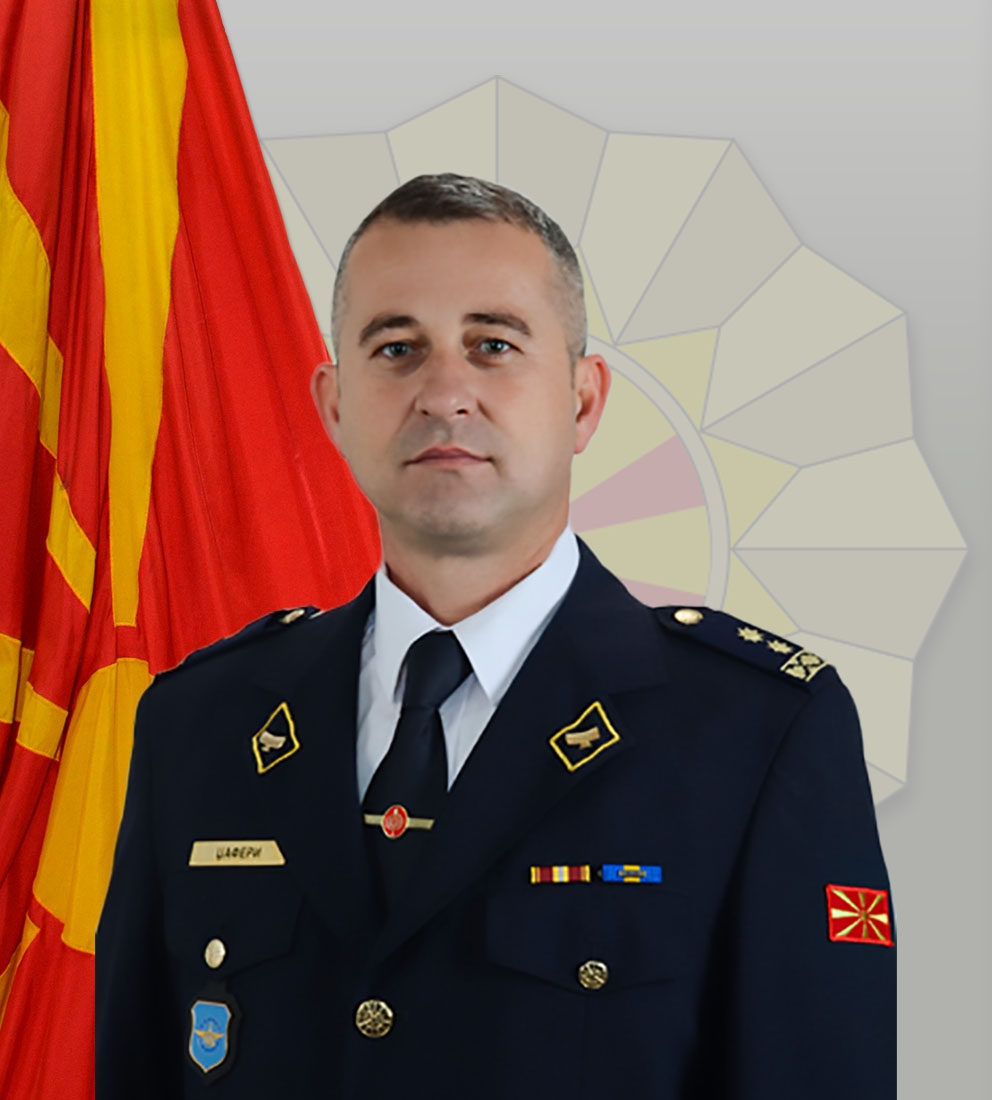
Lieutenant colonel Kjemal Xhaferi
Lieutenant colonel Kjemal Xhaferi was born on 15th October, 1983 in Gostivar. He graduated elementary and high school in Gostivar. He continued his education at the Military Academy “General Mihailo Apostolski” in Skopje. After four years he was commissioned to the first officer rank of Second Lieutenant in the branch of Aviation. He has performed many command duties during his career. On 4th March, 2022, he was appointed as Commander of the Air Surveillance and Reporting Battalion. He attended many courses in the domain of air space management, including Mase Remote Console (MASE) and Process Functions in the Air Space Management Operation Center in Croatia, Course on Exercise Planning organized by DMTC (Canada) in Podgorica, Montenegro, UN Course for Military Observers in UN in Hammelburg in Germany, and other courses. In 2018 he upgraded his military education by completing a Specialization on Command and Staff Duties at the Military Academy “General Mhailo Apostolski” in Skopje. He completed one rotation of peacekeeping mission ALTEA EUFOR in Bosnia and Herzegovina in 2013/2014. He has been awarded and commended many times in his career by the MOD and CGS for his contribution to and development of the Army, including a NATO medal for his contribution to the peacekeeping mission ALTEA EUFOR in Bosnia and Herzegovina. He completed his Master studies in 2018 at the University of “St. Clement of Ohrid” – Technical Faculty – Air Traffic and Transportation in Bitola and gained Master of Science Degree for Air Traffic and Transportation. He is proficient in English language and Judo is his hobby. He is married, father of two children.
Previous appointments:
- 2006, Second Lieutenant, Pilot Listener in the second flight in the Transport Helicopter Squadron in WING;
- 2009, Lieutenant, Civil and Military Cooperation Officer in A-5 Section at the WING Command;
- 2011, Captain, Head of C-4 Section, Logistics Officer at the Air Surveillance and Reporting Battalion;
- 2013, Captain, Commander of the Command and Control Center in Air Surveillance and Reporting Battalion;
- 2017, Major, Head of C-3/5/7 Section in the Air Surveillance and Reporting Battalion;
- 2019, Major, Chief of Staff and Deputy Commander of Air Surveillance and Reporting Battalion;
- 03.2022, Major, Commander of Air Surveillance and Reporting Battalion.
Promotions:
- Second Lieutenant 2006-2008;
- Lieutenant 2008-2011;
- Captain 2011-2016;
- Major 2016-2024;
- Lieutenant colonel 2024.
The foundations of the Macedonian Air Force were set on 6th of April 1992, when the Macedonian President Kiro Gligorov signed Decision No. 60 on forming Air Force and Air Defence Command.
2020-2025
- The unit began a comprehensive modernization process aimed at integrating its capabilities into the NATO Integrated Air and Missile Defence (NATO IAMD).
2019
- Since 2019, the unit has actively participated in the Air Policing mission by executing duties and responsibilities defined in the relevant technical arrangements.
2006-2018
- On 1 March 2006, the unit underwent an organizational transformation, transitioning from the Air Surveillance and Reporting Battalion (ASRBn) to the Air Surveillance Operations Centre (ASOC), and was placed under the direct authority of the Army General Staff.
- The ASOC executed its mission through the collection, processing, identification, and dissemination of the recognized air picture over the Macedonian airspace. This capability was maintained through cooperation with regional air surveillance centers, civil aviation authorities, and NATO, while providing timely early warning of potential and actual air threats.
- Through this unit, the Republic of North Macedonia participated in NATO’s Air Situation Data Exchange (ASDE) programme, which enables the bilateral exchange of air situation data at the regional level. Pursuant to a decision of the Minister of Defence, an Integrated Project Team composed of subject-matter experts from the unit was established to implement the project for a National Air Surveillance and Command Centre.
- As part of the implementation of Partnership Goal PG A2900, relating to airspace surveillance and integration with the NATO Integrated Air and Missile Defence (NATO IAMD), radar coverage over the territory of the Republic of Macedonia was established and enhanced. This included the establishment of a command and control center, as well as the development of policies, procedures, and operational protocols required to support continuous 24/7 air surveillance and command and control operations. In addition, a NATO Air Defence study was conducted to assess the requirements for radar systems procurement, the operation of the command and control center, and organizational changes within the Armed Forces related to air operations and the ASDE programme, which provided the exchange of radar data with NATO air surveillance and control centers.
1994
- On 1 March 1994, in the evening hours, the Air Surveillance, Reporting and Guidance Regiment (ASRGRegt.) received its first recruit soldier.
1992
- On 10 April 1992, the Air Surveillance, Reporting and Guidance Regiment (ASRGRegt.) commenced operations under its newly established organizational and force structure at the barracks, “N.H. Strasho Pindzur” in Petrovec Air Base. During the same year, the Regiment conducted specialized training for guidance controllers, air traffic controllers, radar technicians, and communications personnel.
- At that time, the Air Surveillance, Reporting and Guidance Regiment (ASRGRegt.) did not possess radar systems for airspace control. This capability gap was compensated through the establishment of ground-based Air Observation Posts, manned by personnel acting as visual observers responsible for monitoring designated sectors and air approaches. Coordination was conducted with the Directorate of Civil Aviation, specifically with the Air Traffic Control Centre at Petrovec Air Base, (which operated secondary surveillance radar of the Thomson type), as well as with the Air Traffic Control Centre at Ohrid Airport. The collection, processing, and presentation of air situation data were coordinated and carried out within the Operations Centre of the Air Force and Air Defence Command.


